
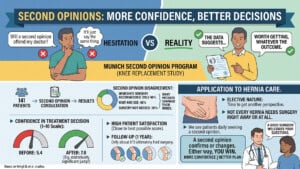
A lot of patients hesitate to get a second opinion because they worry it will offend their first doctor, or they assume it will just tell them the same thing. I think that hesitation is understandable, but the data suggests a second opinion is worth getting almost regardless of the outcome, and I want to walk through why.
Researchers in Munich ran a second opinion program for patients who had already been told by an orthopedic surgeon that they needed a knee replacement. The study, published in BMC Musculoskeletal Disorders in 2021, followed 141 patients through an in-person consultation with an independent knee specialist. Here’s what stood out to me. The second opinion doctor agreed with immediate surgery for only 40 percent of patients. Another 40 percent were told to wait and see how things progressed, and 20 percent were told they didn’t need surgery at all. Among patients who walked in undecided about whether to move forward, a meaningful number changed their minds after hearing the second opinion, and some patients who were leaning one way flipped entirely to the other.
The part I find most useful for patients isn’t the disagreement rate, though. It’s what happened to their confidence. Before the second opinion, patients rated their confidence in their treatment decision at 5.4 out of 10, on average. After, it jumped to 7.8. That’s a big move, and it was statistically significant. Patients also rated their satisfaction with the second opinion process itself very highly, close to the best possible score on the scale used. A follow-up study by the same group, published in BMJ Open in 2023, tracked these patients for a full year and found that only about a third ultimately went through with surgery, which suggests the second opinion process helped some patients avoid an operation they didn’t end up needing.
I think this translates directly to hernia care. Hernia repair is elective in the vast majority of cases, meaning there’s usually time to get another set of eyes on the situation before deciding anything. Not every hernia needs to be fixed right away, and not every hernia needs surgery at all, depending on size, symptoms, and how it’s behaving. We see patients regularly who were told one thing at their first visit elsewhere and want to know if that’s really their only option, or their best option.
My honest opinion is that a second opinion almost never hurts you. If it confirms what you already heard, you leave more confident in the plan. If it changes what you heard, you just avoided a decision you might have regretted. Either way, you come out ahead, and that’s the whole point, doing what’s genuinely best for the patient rather than what’s fastest or most convenient for the schedule.
If you’re weighing hernia surgery and want another perspective before you commit to anything, that’s a completely reasonable thing to ask for. A good surgeon should welcome the question, not take it personally.
What would make you more comfortable asking your surgeon for a second opinion, if you haven’t already?
Source: Weigl M, et al. “Effects of a medical second opinion programme on patients’ decision for or against knee arthroplasty and their satisfaction with the programme.” BMC Musculoskeletal Disorders, 2021.