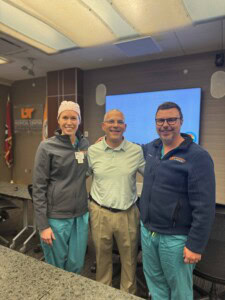
Sharing What I’ve Learned About Inguinal Hernia Repair with the Team at UT Medical Center
The other week I had the opportunity to present at the University of Tennessee Medical Center, and walk their surgical team through how I think about inguinal hernia repair. Having the chance to sit with other surgeons and talk through the reasoning behind a decision, not just the mechanics of it, is where I think the real value of a talk like this is.
My focus was on the repairs I do most, Shouldice and open preperitoneal mesh repair (OPP), and how I weigh them against the techniques most residents see more often: laparoscopic, robotic, and Lichtenstein. I think the honest answer to “which repair is best” is that there isn’t one. In my opinion, the more useful question is which repair fits this patient, and that means being able to speak fluently about the trade-offs across recurrence risk, chronic pain risk, recovery time, anesthesia, and cost, not just the one or two techniques you were trained on.
Patient and surgeon are looking at the same list
One part of this discussion focused on the differences between “patient considerations” and “surgeon considerations.” Patients tend to think first about recovery time, relationships, and quality of life. Surgeons tend to lead with recurrence and patient safety. My point to the room was that this isn’t two competing lists. It’s the same six factors (recurrence, recovery time, chronic pain, patient safety, relationships, quality of life) just weighted differently depending on which chair you’re sitting in. A good conversation with a patient means focusing on all factors, not just the ones that come naturally to you as a surgeon.
Why this kind of talk matters to me
Hernia repair gets taught as a fairly narrow menu at a lot of programs, often centered on whichever technique a given institution favors. I think surgeons benefit from seeing the fuller picture, including approaches like Shouldice that don’t get much airtime outside of specialty practices. I’m very grateful to have been asked to bring that perspective to UT’s team, and to make the case for it with outcomes data rather than opinion.